Automated Driveway Gates in Houston: What to Decide Before You Call a Fabricator
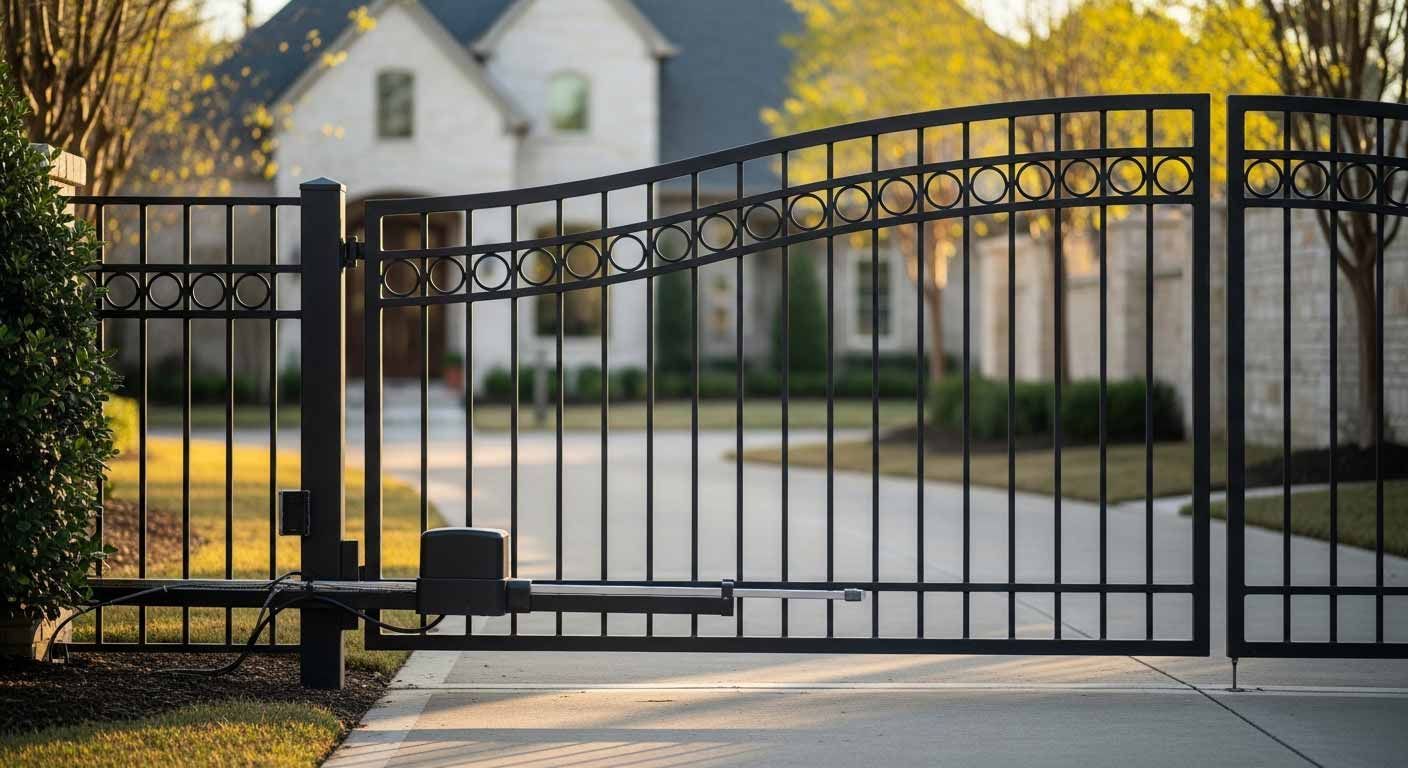
Swing Gate vs. Slide Gate: How Driveway Width and Slope Drive the Decision
Most homeowners picture a swing gate when they imagine a custom iron driveway gate. Two panels opening inward from the center, the look familiar to Memorial and West Houston neighborhoods. That image is right for many properties. But the physical layout of the driveway often settles the question before design preferences get to weigh in.
Swing gates need room to open. A single panel on a 12-foot opening swings through a 12-foot arc when it opens fully. If there's a parked car, a landscaping feature, or a retaining wall in that arc, the gate can't open properly. Double panels split the opening between two shorter leaves, which reduces the arc problem, but swing gates still require clear driveway depth behind them.
Slope is the other factor. If the driveway rises from the street toward the house, a swing gate's arc passes through the rising grade as it opens. Mild slopes can sometimes be managed with gate lifts or modified hinge placement. Steeper grades often make a swing gate impractical and a slide gate the right answer.
Slide gates move horizontally along the fence line rather than swinging through an arc. They handle slope well and work on driveways where swing clearance doesn't exist. The tradeoff is lateral space. A slide gate typically needs about one and a half times the gate width clear along the fence line to retract into. If there's fencing on both sides with no room to extend on either, that limits slide gate options as well.
We look at driveway width, depth, slope, and what's alongside the fence line before recommending a configuration. Our driveway gates page describes the range of work we do.
Single Panel vs. Double Panel Swing Gates and When Each Makes Sense
For properties where swing gates are the right call, the next question is one panel or two.
A single panel works well on narrower openings, often up to around 12 to 14 feet depending on the design and the operator's weight rating. Single panels are structurally simpler and can be automated with lighter-duty operators. They also read cleanly on angled driveway approaches where a double panel's center seam would create an alignment issue.
Double panels split the opening between two equal leaves and carry the traditional look most homeowners in this market are drawn to. They distribute the gate's weight between two sets of hinges and two mounting posts, which matters on heavier iron designs. On wider openings, a double panel is usually the sounder choice regardless of aesthetics.
The decision generally comes down to opening width and design weight. A detailed iron gate on a 16-foot opening should almost always be a double panel. A simpler design on a 10-foot opening often works well as a single.
What Automation Systems Are Available and What Questions to Ask
Gate operators for residential swing and slide gates come from several established manufacturers. LiftMaster, Apollo, and US Automatic are among the brands used in this market. The operator is the motor assembly that drives the gate open and closed. Swing gate operators typically use an articulating arm mounted to the post and gate frame. Slide gate operators use a rack-and-pinion drive along the bottom rail.
Beyond the operator itself, homeowners are choosing between remote-only systems, keypad entry, video intercom, and app-based access. Remote-only systems are the simplest. Keypads add entry for guests and service providers who don't carry a remote. Video intercoms let you see and speak with visitors before opening the gate. App-based systems connect to a smartphone for remote monitoring and control.
Three questions worth answering before committing to a system: Who else needs regular access? How do you want to handle delivery drivers and service appointments? Do you need to be able to open the gate when you're away from home?
How Power Supply, Keypad Placement, and Vehicle Sensor Location Get Worked Out During Design
Three infrastructure decisions affect daily usability in ways most homeowners don't think through until installation day.
Power source: Most residential operators run on standard AC power, which means an outlet or conduit has to reach the gate post. On some properties that's straightforward. On others it requires trenching across the driveway or working around landscaping. Solar-powered operators eliminate that wiring run and generally work well in Houston's climate, provided there's a clear south-facing exposure and correctly sized battery capacity.
Keypad placement: A keypad post needs to be positioned so a driver can reach it without opening the car door. That means accounting for window height, distance from the driveway edge, and how far back from the gate line a car will stop. Getting this wrong creates a frustration that repeats itself every time someone arrives home.
Vehicle sensors: The exit side of the gate needs a sensor that detects departing vehicles and opens the gate automatically. The two common approaches are a buried loop detector cut into the driveway and a probe-style exit wand installed alongside it. Both need to be positioned far enough back that the gate has time to fully open before the vehicle reaches it.
HOA Considerations for Automated Gates
For homeowners in Memorial and West Houston subdivisions, HOA review of a driveway gate project often goes beyond the gate's appearance. Many communities require written documentation on the operator equipment as well.
What Architectural Review Committees in this market often want to see in writing before approval:
- Gate dimensions and material
- Finish color and coating type
- Post height and diameter
- Operator type and housing placement
- Keypad or intercom post location and height
- Whether the installation is visible from the street
Some communities have specific rules about motor arm visibility on the street-facing side of the gate. Others don't distinguish. Contact us once you've reviewed your community's guidelines and we can help you produce a drawing that addresses what the committee is likely to ask about.
One thing that catches homeowners off guard: the HOA reviews the entire installation, not just the gate. Keypad posts, intercom panels, and conduit runs are part of what the committee evaluates. Plan the full installation layout before submitting, not just the gate design.
Why the Automation Equipment Decision Should Happen Before Fabrication Begins
The gate and the operator aren't independent choices. Gate weight determines which operators are rated for the application. Post sizing and placement have to account for where the operator arm attaches. The gate's structural frame has to accommodate the mounting hardware.
If a gate is fabricated before an operator is selected, there's a real chance the mounting points don't align or the gate weight exceeds the chosen operator's rating. Correcting that after fabrication is expensive and sometimes requires starting over on part of the gate.
We work through operator selection during the design phase, before anything goes to the shop. It adds time at the front end and prevents problems further along.
Working with A.G. Metalworks on Your Gate Project
We've been building custom iron driveway gates for homeowners in West Houston and Memorial for nearly 40 years. The layout assessment, panel configuration, HOA drawing, and automation coordination all happen before fabrication begins, not after.
If you're planning a gate project and want to talk through the decisions, reach out through our contact page. We're glad to walk through what your property actually calls for.
Frequently Asked Questions
Does the operator system affect how the gate is fabricated? Yes, directly. Gate weight, hinge placement, and frame construction have to align with the operator specs. The right sequence is to select the operator before the gate goes into fabrication, not after.
How do I know if my driveway slope makes a swing gate impractical? A site visit is the most reliable way to assess this. In general, a driveway that rises more than a few inches across the gate's swing arc creates clearance problems. We look at slope on every project before recommending a gate type.
Do HOAs in Memorial and West Houston typically allow automated gates? Many do, with conditions. Review typically covers the gate design, the operator equipment, and the access hardware as a complete installation. Getting written approval before fabrication is the right sequence, not something to sort out after the gate is already built.


From Consultation to Installation Day: What the Custom Metal Fabrication Process Actually Looks Like